

Image created using CharGen
The most memorable characters aren’t typically the ones who min-max every level and mechanic. Sure, players of these characters often enjoy consistent success in combat and social rolls due to their optimized stat pools and intentionally chosen feats, but what about the opposite kind of player? Some people don’t want to be the Big Hero. There are players who prefer to be the comic relief character and low INT, low WIS characters encourage hilariously suboptimal roleplay and gameplay… as long as you don’t push the envelope too far. Here are some excellent strategies for playing low mental stat characters.
#1 Choose One Dump Stat Intentionally
It can be tempting to make your character a “shitty wizard” by putting as few points into all three mental stats as possible. However, this is one of the first mistakes that prospective “bad thinker” characters make. If you have low intelligence, wisdom, and charisma, you won’t just flub your roleplay rolls. You’ll also miss a lot more saves during fights and in late-game fights, you’ll likely be dead weight since the boss characters can exploit your low stats. Later in the D&D system, magic becomes increasingly important, both for offensive and defensive considerations. This means that players need to be able to effectively make a progressively higher amount of Wisdom, Intelligence, and Charisma saves in combat. Being unable to make those saves will make you pretty unhelpful at best and just outright dead in the worst case scenarios, which totally ruins the vibe of the comic relief character.
To avoid causing table friction from intentionally low mental stats, pick one specific stat that you want to be low and ensure that the other two are high enough to consistently make high-level saves. Your chosen dump stat will influence how you play your character and in what ways their “intellect” is “lacking.”
Think of it this way:
- Intelligence is your practical knowledge
- Wisdom is your ability to apply your practical knowledge to the situation
- Charisma is your ability to influence the thoughts and emotions of other people
Character Examples:
Sheldon Cooper from The Big Bang Theory represents a character who has high intelligence, low wisdom, and low charisma. He’s brilliant when it comes to mathematics and the sciences, but struggles to apply those skills to real world applications, in part due to his awkward personality. He is blunt, often to the point of rudeness, which prevents him from effectively influencing those around him. He’s also extremely socially unaware. He does not pick up on subtext or non-verbal body cues the way someone with a higher Wisdom score would
Geralt of Rivia from The Witcher is a character with low intelligence, high wisdom, and low charisma. No one would dare call him an academic. On the charisma side, his naturally blunt and monotone affect can be extremely off-putting for people who aren’t conditioned to accept it, indicating a lower-than-average level of social skills. However, his Wisdom about the world around him is unchallenged. He has skills in tracking, his ability to perceive not just the environment but also the implications of what he perceives is shown to be versatile and effective, which are products of the Wisdom stat in D&D.
Kronk from The Emperor’s New Groove is a good example of a low intelligence, low wisdom, and high charisma. It might be said that, at least for Millennial and some of the Older Gen Z players, Kronk defines the character trope of high charisma with low intelligence and low wisdom. He couldn’t find his way out of a paper bag, makes bad decisions constantly, but he’s extremely lovable, earnest, and easy to get along with, so everyone likes him even if he’s dumber than rocks.
#2 Let Others Take Lead on the Planning Stage, You’re the Muscle
In the military, there’s a job known as “insertion specialist,” which is basically just a bunch of really huge dudes who kick in doors for a living. That’s you. You dumped your mind stats, which means you’re officially At Least One Big Guy (or Gal, being strong is gender inclusive, of course!). The entire trope of the “dumb” character is that they have to be good at something otherwise they wouldn’t be here. They may not have the street smarts or the book smarts to do complex planning, but kicking a door really hard until it opens? Fair game.
One of the easiest ways to show your character’s lacking intelligence without being an aggravating person at the table is to just allow yourself to be led by people whose roleplay styles make more sense. Even if you know what to do as a player, you have to remind yourself that your character doesn’t have the meta knowledge that the player does. You’ll be making actively suboptimal choices because your character doesn’t know any better. So, instead of trying to fit a square peg in a round hole, fall naturally into the role of “the muscle.”
It might seem counterintuitive or even boring to engage less with planning, but that’s part of the roleplay experience of playing a less intelligent character. The key is that the character has a handler, you. While you should avoid making overreaching meta-informed decisions, especially during combat, even if you were to leave everything to the dice, a character with low mental stats and high physical stats is way less likely to succeed at a mental check versus a physical one.
The good news is that even if you don’t contribute heavily to the planning stage of the game, your character will have plenty to contribute once they move into the doing phase. The secret to playing a character who isn’t very smart without getting in the way of the party’s progression is to focus the character’s efforts into actions that support the party while allowing the player to inject a little bit of “himbo flavouring” to remind everyone that the character is overwhelmingly simple.
When it comes to playing the comic relief character, it’s important to be creative even when you’re deferring to characters who have better in-game skills for battle planning and logistics. You don’t want to be the one that says the same thing every time a new conversation starts. It’s also important to choose a few topics that your character is knowledgeable about. When these topics come up, you can jump in with “Well, actually, I might be simple, but I know a lot about this.” These rare moments of intellectual competency help to reinforce the parts of the story where the character is lacking.
Here’s some inspiration for ways to defer your planning stage to a different player without sounding boring or repetitive.
- “Well, I don’t know nothing about no alchemy and wizardry, I’m gonna sit this one out.”
- “This is not my wheelhouse, call me when there’s an ornery door in your way.”
- “I couldn’t have come up with a plan this good. Really. I would have just suggested punching it.”
- “Is that something you can eat? Uh, maybe this isn’t the place I’m most helpful.”
#3 Say Wrong Things Really Confidently: The Dunning-Kruger Effect
One of the hallmark features of a person who is of lower intelligence is what’s known as the Dunning-Kruger effect. Essentially, the Dunning-Kruger effect is a psychological phenomenon whereby a person’s self-assessment of their own competency is systematically wrong (Duigan & Britannica Editors, 2026; Dunning & Kruger, 1999). For someone with high natural intelligence, this shows as underestimating their skills (Duigan & Britannica Editors, 2026; Dunning & Kruger, 1999). People with a large amount of knowledge in a subject know what they don’t know and often feel a sense of imposter syndrome, shying away from opportunities to show their knowledge lest someone start expecting things from them. People with low measurable knowledge in a subject often overestimate their ability to understand it and see themselves as “naturally above average” when they’re dead average on their best days (Duigan & Britannica Editors, 2026; Dunning & Kruger, 1999). This disconnect is a type of metacognitive bias, a systematic error in the judgement about the self’s way of thinking.
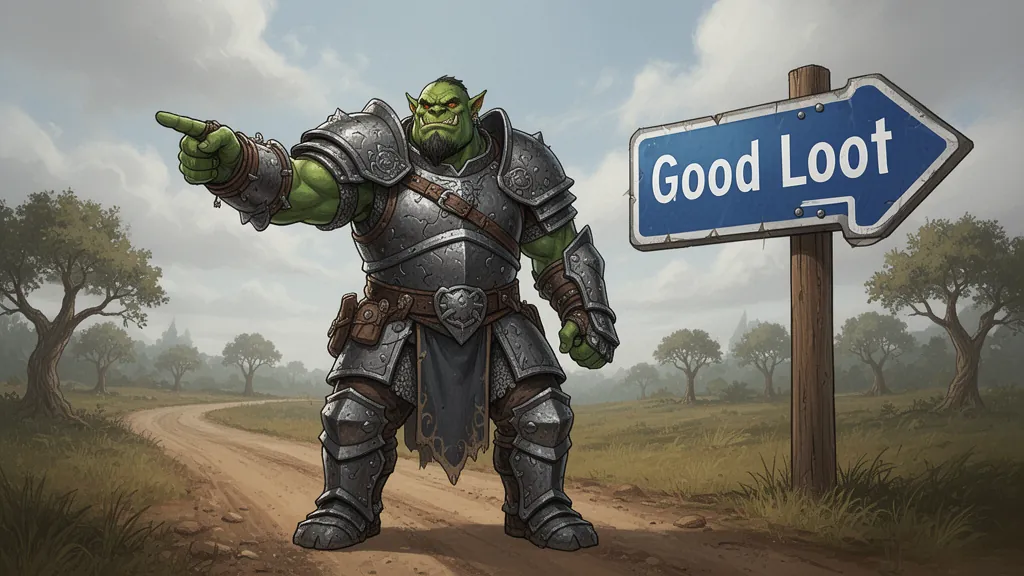
Image created using CharGen
There are two ways to use the Dunning-Kruger effect in roleplay to solidify your character’s personality as “the lights are on but no one’s home.” The secret is to separate your cognitive and metacognitive biases. This is a place where preparation is key. It’s much harder to apply cognitive and metacognitive biases in real time; normally the process is passive, your mind just automatically is drawn to a conclusion from the information it has, including your biases. So, prepare some lines in advance (if you have some funny ones ready to whip out on the fly, you’ll be more likable without derailing the game).
Cognitive Bias: Being Wrong About the World
A cognitive bias is when the brain’s information is incomplete or incorrect, leading to incorrect beliefs about the world. This is a thinking error in which the person who is thinking fails to accurately judge the state of external reality. Cognitive biases are an error in interpreting the information you are given.
Examples
- “All undead hate garlic. Everyone knows that.”
- “Sharks must be common because I saw one at the beach last week.”
- “If it’s glowing, it’s probably friendly.”
- “Treasure chests only turn into Mimics when you’re nervous.”
- “Monsters only chase you if you run, if you stand still they get confused.”
- “Mimics only eat rich people furniture.”
- “Nothing that big can climb stairs.”
- “Potions work faster if you shake them.”
- “All magic comes from the moon. That’s why it shines.”
- “If two people cast the same spell at the same time, it becomes twice as friendly.”
- “The only difference between nobles and commoners is that nobles have better hats.”
- “Always charge at the biggest one. That’s the leader.”
- “If you say ‘official business’, doors legally have to open.”
Let the party correct you. When they do, they’re engaging with your character’s specific arc (as an adventurer’s lack of intelligence will influence the way their arc progresses). Consider these little moments between party members as a crucial learning moment for your character. Even though you know what you’re saying is wrong, your character doesn’t (that’s the whole point). So, don’t be afraid to be loudly, unabashedly incorrect with your worldly knowledge.
Metacognitive Bias: Misunderstanding Yourself
So, technically speaking, metacognitive biases are a subset of cognitive biases. (All metacognitive biases are cognitive biases but not all cognitive biases are metacognitive.) However, psychologists separate the megacognitive biases into their own category because they are fundamentally different from cognitive biases in that they are specifically focused on the self.
You can think of metacognition as being thinking about thinking. When you assess your own thought process, rather than what you said, you’re engaging in metacognition.
The difference between metacognition and cognition is as follows:
- Cognition: “I don’t see any traps.”
- Metacognition: “I’m good at spotting traps.”
When playing a less intellectual character, adding positive metacognitive statements to incorrect facts can help enhance your character’s personality and emphasise their simplicity.
Examples
- “I’m good at spotting traps and I can’t see any, so there must not be traps.”
- “I have excellent instincts. I think he’s telling the truth.”
- “I’m basically a troll expert, and I know trolls hate water.”
- “Anyone can track. You just follow the ground.”
- “I vibe checked it and I think it’s cursed.”
- “I’m resistant to magic, mentally.”
- “They won’t attack us—I smiled at them.”
#4 Ask Obvious Questions
One way you can emphasise your character’s simplicity is to occasionally interject with a low-stakes, extremely obvious question. Characters with low intelligence or wisdom (or both…) need to consistently reaffirm their role in the social dynamic because it can be easy to overestimate characters in a game. Some people play Dungeons & Dragons because they want to build a story with their friends. Others play it more like an actual game that they win by defeating monsters and not dying. Players who play the game as a game first and a story second might forget that your character has a gimmick that affects the outcome of the dice rolls and assume you’re able to do things that you can’t because your stats are too low.
By occasionally interjecting with a very obvious question, you remind everyone “Hey, I’m here… and I’m still a himbo. Adjust your expectations accordingly.” Just like the genius wizard wants to interject magic facts and lore to seem smarter, your character wants to interject with not knowing. Questions like “So, the dragon is the big lizard in the middle of the room, right?” or “How do we know the map isn’t lying?” create humour out of seemingly normal situations within the game and more importantly they don’t step on anyone’s toes.
Examples
- “Why do we knock on doors in a dungeon? Who’s going to answer?”
- “If we already killed the guards, why are we still sneaking?”
- “What happens if we go the wrong way on purpose?”
- “How do mountains stay up?”
- “Where does the road go when it ends?”
- “How does the sun know where to rise?”
- “Is north the same north every day?”
- “Do rivers ever get tired of flowing?”
- “If magic is real, why do we still need doors?”
- “Can you un-cook food with ice magic?”
- “If a werewolf is wearing pants, do the pants turn too?”
- “Do we get paid extra if it’s scary?”
- “Do candles get shorter or does the room get bigger?”
- “If I dig down forever, do I eventually hit the sky again?”
- “Where does the dark go during the day?”
#5 Keep the Stakes Low: PVP Is Strictly Prohibited
What makes a gimmick character good is when they’re memorable without being a nuisance. Characters with intentionally low stats can be irritating when they’re constantly flubbing rolls and getting into trouble as if they were a toddler again. So, it’s important to keep the stakes low. You want your character’s simplicity to shine in roleplay and not in mechanics. While low rolls are inevitable, you want to minimize the amount of damage your character introduces to the team synergy.
By keeping your character’s gimmick to low stakes situations, you prevent your character from becoming the party’s roadblock to progression. The critical negotiation your party is mediating between nations? Let your character be the background noise so they don’t disrupt the story with awkward social skills. Right before the party fights a common enemy? That’s the time for you to shine. Trying to get information at the tavern? This is the place for you to have your fun.
Most dungeon masters have a specific rule against player-versus-player actions because they are so disruptive and cause unnecessary friction between people who are supposed to be working together. Usually they will interject if they feel your action is harming the other party members. However, you shouldn’t rely on the dungeon master’s judgement alone to determine what actions you can take for your gimmick. The dungeon master is, by design, your enemy in the game. They’re the narrator and they play every villain. They’re much more tolerant of actions taken against them because they are literally the target of every party action. Your dungeon master may not pick up that another play felt put off by your decision or roleplay. A good rule of thumb is to ask, out of character, if something is important. You want to pose this question to the whole table, because some people may give different answers. If someone says something is important to them, don’t ruin it. They’ll appreciate your kindness and, in turn, give you more opportunities to play your gimmick if it doesn’t disrupt their gameplay.
References
Duigan, B., & Britannica Editors. (2026, January 23). Dunning-kruger effect | definition, examples, & facts | britannica. Britannica. https://www.britannica.com/science/Dunning-Kruger-effect
Dunning, D., & Kruger, J. (1999). “Unskilled and unaware of it…” Journal of Personality and Social Psychology, 77(6), 1121–1134.
- About the Author
- Latest Posts

When I’m not writing about RPGs, I’m playing Dungeons & Dragons, Magic: the Gathering, Yu-Gi-Oh!, X-Wing miniatures, and many other lovingly-crafted tabletop games with the people I love.