

Image created using CharGen
Introduction
On some levels, every character that is played in Dungeons & Dragons occupies a space where they are both smarter and dumber than the player at the same time. The character lacks high-level meta-knowledge, and in this regard, the player is almost godly compared to the character. Knowing exactly what spell to cast to deal the most damage? That’s knowledge most characters don’t have. The character, on the other hand comes prebaked with in-world knowledge from their backstory and common sense explanation within the world (for instance, you, the player, do not need to actually know what a bugbear is for your character to know what a bugbear is). However, if you’re worried about your mad scientist character falling flat because you don’t have an alchemy degree, let’s examine some mechanical ways you can make your character seem smarter in action.
#1 Research
The most cost-effective way to increase your character’s knowledge is to increase your own knowledge. If you already know what adventure your DM is running, do some pre-research into the types of monsters your character might encounter in that setting. A character with an advanced degree or a battle-hardened soldier will have more knowledge about the world than a greenhorn adventurer. By arming yourself with additional knowledge about the setting, you enable your character to make more informed decisions, which, in turn, makes them appear smarter because they seem to “just do it” effortlessly, mirroring how a character with actual training would be more competent.
There are multiple domains that a player can research when looking to increase their knowledge of the setting for play reasons. The first resource you should consult is, of course, the Player’s Handbook. The goal of this research isn’t to become a “rules lawyer.” You’re not trying to argue the rules with the dungeon master. The purpose of this research is to cement the kind of otherworldly knowledge a high INT/high WIS character would have gleaned. The backstory for most genius characters includes formal education or some type of self-study. Thus, it makes sense for characters who fall into this category to actually have and utilize superior meta knowledge.
A character who attended the world’s most prestigious university probably knows a little more about the inner workings of the world. They may have additional knowledge about damage types, monster weaknesses, and magical items. By pre-researching these topics, you’ll be able to pull them out in-game without any additional checks, making your character appear more competent on the surface.
If you know the module that your dungeon master wants to run for your group, you can research the module in advance. You don’t need to spoil the story. Start by looking at the setting information. What history does the world have that your character can draw from to give the appearance of superior knowledge and critical thinking.
Definitely talk to your dungeon master before you start researching individual modules, though. The dungeon master might have plans for your group that could be disrupted by your additional knowledge. If the dungeon master indicates that they have special plans for your party, you should keep your research to a relatively high level of abstraction. For instance, instead of researching each monster that appears individually, simply collect a list of the monsters you might encounter without any supporting details that could derail or demystify the dungeon master’s grand architecture.
This issue can also be solved through in-game communication. If you’re unsure if the dungeon master is planning a deviation from the standard run of the module, it never hurts to ask “Out of character, is this a really important progression point or can I use meta knowledge?” Dungeon masters might feel put out if you constantly rig their world with meta knowledge, but a few good inserts of meta knowledge can carry your character’s entire backstory with memorable anecdotes.
One thing about researching the game in order to play genius characters is that the process is cumulative. The more genius characters you play, the more knowledge you will naturally gain. If you already know the bugbear’s weaknesses off the top of your head, you don’t need to study it again.
#2 Be Curious
The idea that one should “be curious” might sound like typical inspirational speaking, but curiosity is one of the hallmark features of high intelligence. Many people think of “intelligent” people as “knowing a lot of things.” However, it’s more accurate to say that the most intelligent people ask a lot of questions. Highly intelligent people are more acutely aware of what they don’t know than the average person (consider the Dunning-Krueger Effect for evidence). What separates a highly intelligent person from an average person is that the highly intelligent are constantly seeking new information. When a highly intelligent person finds a problem that they don’t understand or information that they don’t know, they don’t feel threatened by it. Instead, the highly intelligent person seeks out a person who knows and then they learn the information and become a person who knows.
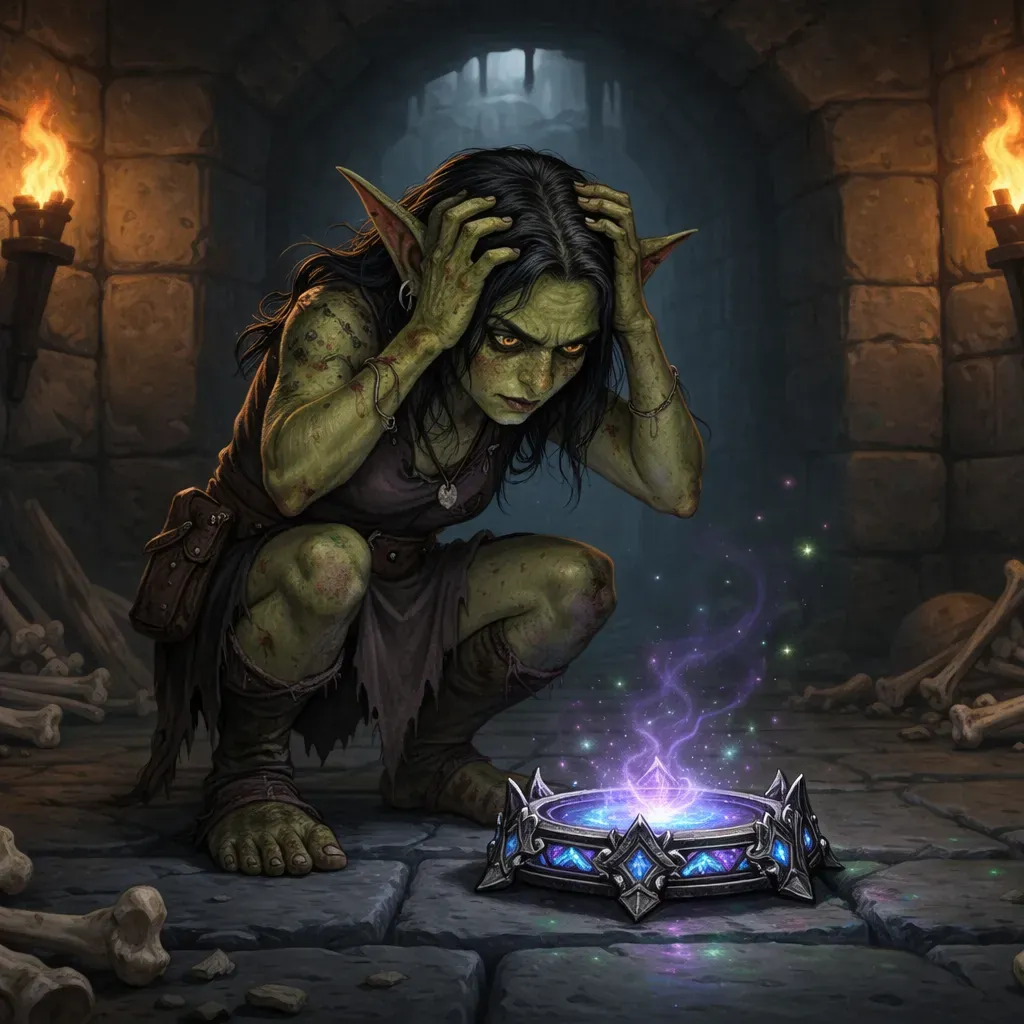
Image created using CharGen
So, how can we apply this to Dungeons & Dragons? Regardless of the format, games are about information. The winner of the game is the one with the most information, not the one with the highest stats or most natural talent.
Other people pick up on this as well. When people witness someone with an insatiable curiosity, they come away with a sense that the person is intelligent. The key is to ask good questions, not just asking about everything. An intelligent person can add value to a conversation even when they’re requesting more information.
Asking good questions means moving from granular, specific questions to more open-ended, high-level, abstract questions. As a rule of thumb, if the answer to a question is a simple “yes” or “no,” the question is not at a high enough level of abstraction to warrant asking. There are times where a yes/no question is avoidable, and you will know when those times come (critical progression information, searches for specific items, attempting certain magicks). However, if you ask too many simple questions, it makes your character look less intelligent, not more intelligent. A simple person sees an empty office and says “I check the desk. Is there something behind it? What about in the drawers?” but a person who operates on a higher baseline of intellectual processing will see the whole room as an ecosystem of interconnected concepts. The intelligent person asks, “I investigate the room, what information do I find while searching?” By giving the dungeon master the ultimate authority to dispense information, you make your character look curious and interested without overwhelming the table with questions that don’t give enough information on their own.
Below is a go-to list of questions you can fall back on when creativity runs short:
- “What do I find?”
- “Who do I see?”
- “Where am I?”
- “Can I tell how long it’s been since this happened?”
- “How was this person killed/injured?”
- “What is the history of this place/item?”
- “Do I sense any magic spells cast on this place/item?”
- “Is there anything notably unusual about this place/item?”
- “What kind of emotional response is this person displaying?”
- “What language does this creature/person speak? Do they have a notable dialect or accent?”
- “With 20 INT/WIS and my backstory as an academic/acolyte/wizard/etc., what would I already know about this situation?”
- “Who benefits from this place/item/circumstance?”
- “Do I recall any information about this place/item/circumstance?”
These kinds of questions give heaps of information while giving the dungeon master exclusive control over the flow of information, preventing the player from entering a “PVP” situation between themselves and the dungeon master.
#3 Use Abilities to Simulate Intelligence Through Mechanics
A lot of abilities and actions in the Dungeons & Dragons world can be used in place of actual, applied knowledge. Using these abilities liberally does more than just help your party and improve action efficiency, it also makes your character look smarter. One thing that smart people do is influence and change the world. Top earners with high intelligence in the world, like Bill Gates and Jeff Bezos, don’t just sit in their caves and learn, they use that knowledge to change the world and mould it to their will.
Your character doesn’t have to be a multibillion gold philanthropist to exercise their “knowledge” of the world to help the party. The game has baked in a wide variety of Button-Press spells that flex a character’s existing knowledge without tapping the player’s brain at all.
Help Action
The “Help” action is one that not all players can use at all times. According to the rules, a player can only use the “Help” action on another character if they could perform the task by themselves given a high enough roll. For instance, a -2 INT character probably can’t help the Wizard perform an Arcana check to identify runes.
However, when playing high intelligence characters, it’s worth keeping an eye on your proficiencies to see if you can use the “Help” action.
Here’s how the rules define the “Help” action:
“You can lend your aid to another creature in the completion of a task. When you take the Help action, the creature you aid gains advantage on the next ability check it makes to perform the task you are helping with, provided that it makes the check before the start of your next turn.
Alternatively, you can aid a friendly creature in attacking a creature within 5 feet of you. You feint, distract the target, or in some other way team up to make your ally’s attack more effective. If your ally attacks the target before your next turn, the first attack roll is made with advantage.”
It’s never a bad idea to be liberal with the “Help” action. The worst thing that can happen is the dungeon master telling you that you can’t do it. So, if you notice an action your character might have knowledge in from their backstory, ask the dungeon master if you can use the Help action to simulate that knowledge through game mechanics.
Enhance Ability
“Enhance Ability” is a transmutation designed to support the players and make passing intelligence ability checks easier. It is an excellent vehicle of progression because it forces the target player to be better at what they’re doing on a mechanical level. Like with the “Help” action, “
“Enhance Ability” improves the chances that a player can pass a check. However, unlike “Help” instead of gaining advantage, the target player gain bonus stat points to a specific stat. “Enhance Ability” can be used on any stat without needing proficiency and has built in flavor for each stat. The idea behind this spell is that you’re magically enhancing their natural talents rather than “helping them complete the task.” Enhanced natural talents turn into higher modifiers and better rolls on ability checks.
The rules for “Enhance Ability” are as follows:
Enhance Ability
2nd level Transmutation
Casting Time: 1 action
Range: Touch
Target: A creature
Components: V S M (Fur or a feather from a beast)
Duration: Up to 1 hour
Classes: Artificer, Bard, Cleric, Druid, Ranger, Sorcerer, Wizard, Occultist, Spellblade
You touch a creature and bestow upon it a magical enhancement. Choose one of the following effects; the target gains that effect until the spell ends. Bear’s Endurance. The target has advantage on Constitution checks. It also gains 2d6 temporary hit points, which are lost when the spell ends. Bull’s Strength. The target has advantage on Strength checks, and his or her carrying capacity doubles. Cat’s Grace. The target has advantage on Dexterity checks. It also doesn’t take damage from falling 20 feet or less if it isn’t incapacitated. Eagle’s Splendor. The target has advantage on Charisma checks. Fox’s Cunning. The target has advantage on Intelligence checks. Owl’s Wisdom. The target has advantage on Wisdom checks.
At Higher Levels: When you cast this spell using a spell slot of 3rd level or higher, you can target one additional creature for each slot level above 2nd.
Keen Mind
A lot of players criminally underestimate how powerful some of the features of the “Keen Mind” feat are. The feat gives the following benefits:
You have a mind that can track time, direction, and detail with uncanny precision. You gain the following benefits.
Increase your Intelligence score by 1, to a maximum of 20.
You always know which way is north.
You always know the number of hours left before the next sunrise or sunset.
You can accurately recall anything you have seen or heard within the past month.
In a game where the primary gameplay loop is walking and hoping you’re going in the right direction, knowing which way is north can be extremely powerful. The thing that this description fails to elaborate on is that if you know which way is north, you actually know all four cardinal directions because you can simply turn in a circle like a compass.
Knowing how much time is left before the end of the day is excellent for so many things. Some monsters have time triggers or attacks and skills that change during the night (werewolves, for instance). Additionally, a player who knows how long is left in the day knows how long the party has to finish their current tasks before the world becomes infinitely more dangerous in an instant.
Observant
Like “Keen Mind”, the “Observant” feat changes the way your character interacts with their environment by granting them additional information about it. The Player’s Handbook describes this feat as such:
Quick to notice details of your environment, you gain the following benefits:
Increase your Intelligence or Wisdom score by 1, to a maximum of 20.
If you can see a creature’s mouth while it is speaking a language you understand, you can interpret what it’s saying by reading its lips.
You have a +5 bonus to your passive Wisdom (Perception) and passive Intelligence (Investigation) scores.
The “Observant” feat is extremely good for simulating passive intellect in your character by boosting their passive Perception and Investigation skills. This means that your character will operate with more information than their counterparts because of their high passive Perception and Investigation, allowing them to be the “informer” character in the party.
#4 Roll for Everything
Finally, it’s possible to just let the dice decide. Statistically, high stats will yield better dice rolls. So, it’s entirely possible to check out of playing the roleplaying game and start playing the mathematical game. Stack your INT and WIS as high as possibly can and then every time you want to do something, request to roll. The most intelligent people utilize systems to their advantage. The system to succeed at what you want to do—without having to be a super genius yourself—already exists in the dice system. You don’t have to “act out” everything you do. Sure, it increases immersion and it’s fun, but you can also just say, “I want to roll to XYZ.” and leave it at that.
Rolling proactively is one place where players can flex their creativity while also utilizing the mechanics to perform feats beyond their personal capabilities. Here are some go-to questions you can use to fish for information without meta-gaming the system too hard.
- “Can I roll History to recall similar events?”
- “Arcana to recognize the spell?”
- “Nature to identify tracks?”
- “Investigation to reconstruct what happened?”
- “Perception to notice anything unusual?”
- “History to remember why this place is important?”
- “Arcana to detect any spells in the area?”
- “Nature to identify the remains of this creature?”
- “Insight to see if this person is telling the truth?”
Conclusion
Playing a character smarter than you doesn’t have to feel like “faking it until you make it.” Using open communication, preparatory research, and liberal use of in-game mechanics to succeed, you can have your character operate at the efficiency of a genius even if you’re pretty regular. Remember to ask questions, roll often, and research the module you’ll be playing for the most success playing a high INT/WIS character.
References
Crawford, J., Perkins, C., Petrisor, B., Schneider, F. W., Winninger, R., Wyatt, J., & De Armas, M. (2024). Dungeons & dragons 2024 player’s handbook. Wizards of the Coast LLC.
- About the Author
- Latest Posts

When I’m not writing about RPGs, I’m playing Dungeons & Dragons, Magic: the Gathering, Yu-Gi-Oh!, X-Wing miniatures, and many other lovingly-crafted tabletop games with the people I love.