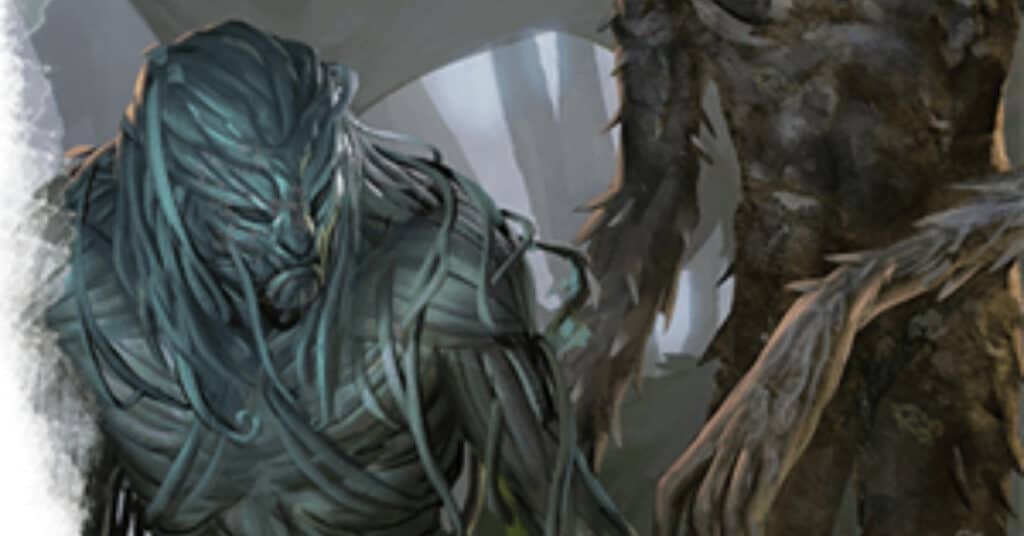


What lurks in the darkness of the graveyard, roaming through the mist-shrouded night in ravening packs, ever on the hunt for human flesh? That’s right, it’s the goth’s natural predator: the Ghoul.
Man, I love ghouls.

Whether we’re playing 1980s B/X D&D or 5e, ghouls are easily one of my favorite varieties of undead horror to strike terror and revulsion into the hearts of budding adventurers everywhere. In this guide, we’re going to give you the low-down on ghouls in 5e, from their stats and abilities to history, suggested encounters, and how to use them in your own campaign.
Stat Block: Ghoul
Medium Undead, Chaotic Evil
- Armor Class: 12
- Hit Points: 22 (5d8)
- Speed: 30 ft.
- STR 13 (+1) DEX 15 (+2) CON 10 (+0) INT 7 (-2) WIS 10 (+0) CHA 6 (-2)
- Damage Immunities: Poison
- Condition Immunities: Charmed, Exhaustion, Poisoned
- Senses: Darkvision 60 ft., Passive Perception 10
- Languages: Common
- Challenge: 1 (200 XP)
- Proficiency Bonus: +2
Actions
Bite. Melee Weapon Attack: +2 to hit, reach 5 ft., one creature. Hit: 9 (2d6 + 2) piercing damage.
Claws. Melee Weapon Attack: +4 to hit, reach 5 ft., one target. Hit: 7 (2d4 + 2) slashing damage. If the target is a creature other than an elf or undead, it must succeed on a DC 10 Constitution saving throw or be paralyzed for 1 minute. The target can repeat the saving throw at the end of each of its turns, ending the effect on itself on a success.
Suggested Ghoul Encounters
- Suggested Party Size: 3-4
- Suggested Party Level: 2-3
Quick Tactics for Ghouls
- Hit and run
- Follow like vultures
- Stupid doesn’t mean mindless
Ghouls are in possession of a terrifying paralytic poison, which means that they hunt like poisonous or venomous animals, striking, then waiting to see if their poison does the work for them. Therefore, a ghoul pack tracking a gang of PCs can make the most of its decent movement speed, good darkvision, and likely home-turf advantage to follow their prey, sometimes openly like vultures waiting for a moment of weakness.
A ghoul should run into melee range (preferably with the element of surprise) to hit an enemy. If they are paralyzed, the ghoul presses on to the next possible target. As a rule of thumb, for maximum effect, half the ghouls present (rounding up) should be trying to paralyze a new target each round while the rest make attacks against paralyzed targets.
This can be extremely deadly and punishing, particularly if the ghouls fight with no regard for their own safety. However, unless they’re under the command of a much more powerful undead or have no other choice, ghouls shouldn’t be played as especially brave. They retreat if their enemies put up too much of a fight or if one of their own is killed. If they can drag a dead or paralyzed body away with them, all the better.
What Is a Ghoul?
A ghoul is a type of CR 1 undead that uses its poison-coated teeth and claws to subdue its prey. These creatures roam the night in packs, particularly in crypts, graveyards, and dungeons but also battlefields, relentlessly searching for human flesh to devour.
Ghouls thrive in places that are rank with decay and death and anywhere where there is death and decomposition in abundance. Preferring the taste of putrefying, rotten flesh to that of the living, ghouls are nevertheless opportunistic carnivores, although they are much more intelligent than most people expect. This has been more than a few adventurers’ downfall, as these creatures are more than capable of thinking tactically, setting traps, and even negotiating.
Where Do Ghouls in DnD 5e Come From?
Ghouls have been a part of D&D’s monster manuals since the earliest editions of the game, and their basic design hasn’t changed all that much in almost 50 years. Even in OD&D, a ghoul was a relatively weak undead monster with a nasty paralysis effect that could easily turn a run-of-the-mill random encounter into a TPK.
The monsters on which they’re based trace their roots all the way back to prehistoric Arabic folklore — who in some stories were desert demons believed to rob graves and devour corpses and in others were malevolent hyena spirits who would lure away unwary travelers to devour them in the desert, which actually sounds more like gnolls than our modern idea of a ghoul.
Later on — around the second half of the 19th century or when modern medicine and the widespread study of anatomy were making the practice of graverobbing into a seller’s market, resurrectionists were also commonly referred to as “ghouls.”
In D&D 5e, ghouls can trace their origins back to the Abyssal plane. Doresain, the first of their kind, was an elf worshiper of Orcus, the demon prince of undeath, who turned on his own people. He feasted on the flesh of men and elves, and as a reward for his service, Orcus — never one to let talent go unrecognized — made him into a ghoul.
For millennia, Doresain served Orcus faithfully in the Abyss, creating ghouls from the demon lord’s other servants. Then, an incursion by Yeenoghu, the demonic Gnoll Lord (gnolls again?), ousted Doresain from his throne. Orcus — never one to let a lack of talent go unpunished — refused to intervene on his behalf, and Doresain turned to the elf gods for salvation. For frankly baffling reasons, the elven gods took pity on the king of ghouls and helped him escape certain destruction. Since then, elves have been immune to the ghouls’ paralytic touch.
How To Run Ghouls in DnD 5e
First and foremost, I urge you not to underestimate the ghoul in combat for one simple reason: they are absolute death spiral machines.
A death spiral is where one action negatively impacts the PCs ability to win, meaning it’s more likely more bad things will happen that make it even less likely the PCs will win, and it all happens so fast, exponentially increasing in severity, that there’s not much the PCs can do to avert catastrophe.
The ghoul’s death spiral occurs when a single PC fails a save against the ghoul’s paralyzing claws. Typically, the PC won’t have too many hit points; these are probably low-level characters after all. Then, the ghoul switches from its claw attack (2d4 + 4), switches to its bite (2d6 + 4), and hits the now paralyzed PC again.

Let’s just take a real quick look at how the rules for paralysis work, shall we?
A Paralyzed creature cannot take actions, reactions, or movement, nor can they speak. They fail all DEX and STR saves. All attacks against them have advantage. Successful melee attacks are critical hits.
That’s right. Not only is the ghoul making its next bite attack with advantage, but if it hits, the attack is automatically a critical for a whopping 4d6 + 4 damage. That’s enough to knock a lot of 1st- and even 2nd-level characters unconscious — at which point the ghoul just attacks again because it’s not fighting anymore: it’s feeding.
A ghoul with its blood up is going to need to be attacked by someone else to get it to leave a downed PC alone, and if there is more than one ghoul in play, this horrible little drama could be playing out all over the battlefield.
Now, obviously, things could go very differently if the PCs have a couple of elves in the party, don’t get hit by the first round of claw attacks, and make their saving throws if they do. The ghouls could be a really easy fight… or they could be a waking nightmare that claims the lives of multiple party members in under three rounds of combat.
Of course, for the same reason I’d rather fight a whole pack of wolves than one naked Florida Man high on bath salts, ghouls are made a lot less dangerous if you don’t run them like other undead. They’re relatively intelligent (7, which I like to think of as around a four- or five-year-old child) and know a language, which means they can negotiate, taunt their enemies, make plans (whether they stick to them is another matter), and fear for their safety.
A basic zombie is going to rush into combat and keep fighting until it’s dead or you are. A ghoul just wants dinner or to be left alone while it eats its dinner.
Therefore, I prefer to think of these creatures more as environmental hazards to be bribed with offerings of rotten meat, or even temporarily allied with — they’re definitely smart enough to get involved in faction play.
So those are my thoughts on using ghouls to murder, or hopefully not murder, an entire party of PCs in just a few rounds of combat. Stay safe out there, adventurers, and keep out of the graveyards.
- About the Author
- Latest Posts

I played my first tabletop RPG (Pathfinder 1e, specifically) in college. I rocked up late to the first session with an unread rulebook and a human bard called Nick Jugger. It was a rocky start but I had a blast and now, the better part of a decade later, I play, write, and write about tabletop RPGs (mostly 5e, but also PBtA, Forged in the Dark and OSR) games for a living, which is wild.